
《TAIPEI TIMES》China military buildup poses threat to energy security - 焦點 - 自由時報電子報
2025/03/02 03:00
By Liu Yu-chieh and Jonathan Chin / Staff reporter, with staff writer
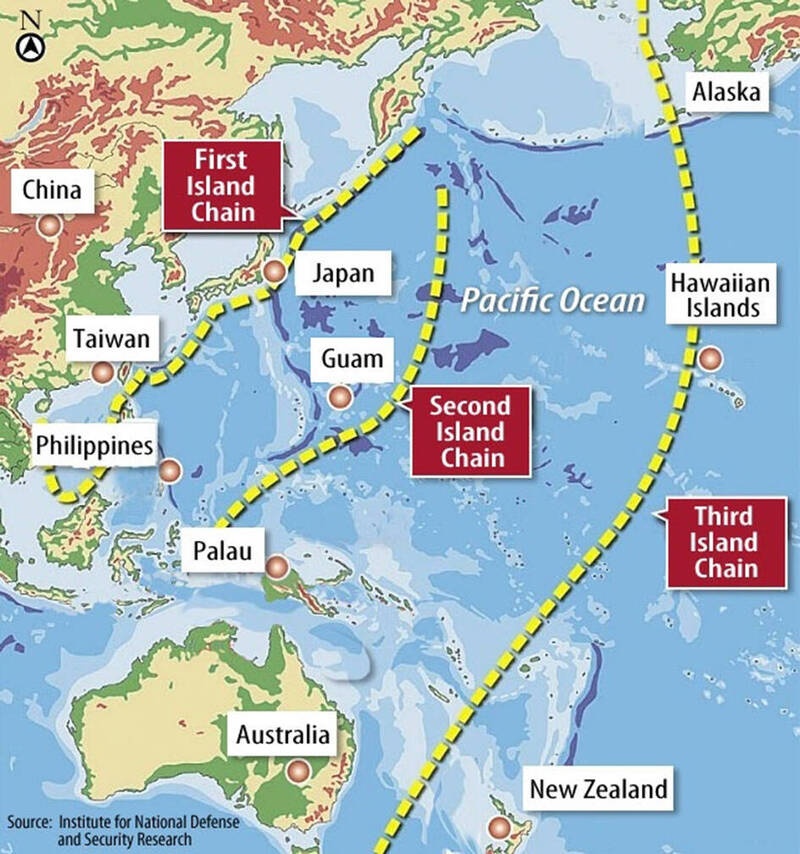
China’s military buildup in the southern portion of the first island chain poses a serious threat to Taiwan’s liquefied natural gas (LNG) supply, a defense analyst warned.
Writing in a bulletin on the National Defense and Security Research’s Web site on Thursday, Huang Tsung-ting (黃宗鼎) said that China might choke off Taiwan’s energy supply without it.
Beginning last year, China entrenched its position in the southern region of the first island chain, often with Russia’s active support, he said.
In May of the same year, a Chinese People’s Liberation Army Navy (PLAN) force consisting of a Type 054A destroyer, Type 055 destroyer, Type 052D destroyer and Type 0903 supply ship was spotted in the Sibutu Passage, a strategically important sea lane off Malaysia that links the Sulu Sea and Celebes Sea, he said.
In June of that year, a PLAN force consisting of a Type 071 amphibious transportation dock and three other warships were spotted in the waters southeast of Pilas Island in the Sulu Archipelago of the Philippines and north of Santa Cruz Island in the Basilan Strait, he said.
In July, Russia held the Ocean-2024 exercise in the South China Sea — a large strategic naval drill including more than 400 ships, submarines, support vessels and 120 naval aircraft — with China participating as a key partner, he said.
In October of that year, a PLAN carrier strike group with the aircraft carrier Liaoning as the centerpiece was spotted sailing in the direction of Indonesia’s Sulawesi island in the seas southeast of the Philippine island of Mindanao, Huang said.
One month later, China’s ally Russia held the Orruda-2024 bilateral naval exercise with Indonesia in Surabaya, Indonesia, and the adjacent Java Sea — with Russian Minister of Defence Andrey Belousov saying the exercise is designed to repel “large-scale aggression of a potential enemy.”
The events, coupled with the Chinese bases on Subi Reef (渚碧礁), Mischief Reef (Meiji Reef, 美濟礁) and Fiery Cross Reef (Yongshu Reef, 永暑礁) show that the PLAN is growing more advanced and capable of extending the range of its operations, Huang said.
They also showed that Beijing’s strategy is to penetrate through the Sulu Sea running from the South Luconia Shoals (南康暗沙), claimed by Taiwan, Malaysia and China, to the Philipines’ Balabac Strait and Leyte Gulf, he said.
Most importantly, they evidenced an intention to not only secure an alternative sea line of communication to the Malacca Strait, but to also threaten a line of communication on which Taiwan would depend during wartime for its energy supply, Huang said.
Disrupting Taiwanese LNG access would significantly undermine the nation’s resilience during a conflict, he said.
This means that China could harass or expel LNG carriers to strike at Taiwanese morale and the credibility of its government without having to blockade or isolate it entirely, Huang said.
The French-led multinational naval drills Exercise La Perouse and Exercise Pacific Steller, held from Jan. 16 to 24 and last month respectively, and involving nine nations — Australia, Canada, France, India, Indonesia, Malaysia, Singapore, the UK and the US — simulated pincer movements at the northern and southern end of the first island chain, he said.
These exercises, which involved carrier-type capital ships from the US, Japan and France, suggest the US and its allies are cognizant of the threat China’s advancements pose, he said.
Huang urged the government to monitor and respond to the developing situation in concert with friendly states including the US and Japan, while improving intelligence sharing with the Philippines.
Closer links with the Australian military are also needed for the nation to confront the new threat, he said.
新聞來源:TAIPEI TIMES